
A Brief History of Cambridge University
Key takeaways:
One of the world’s most prestigious universities
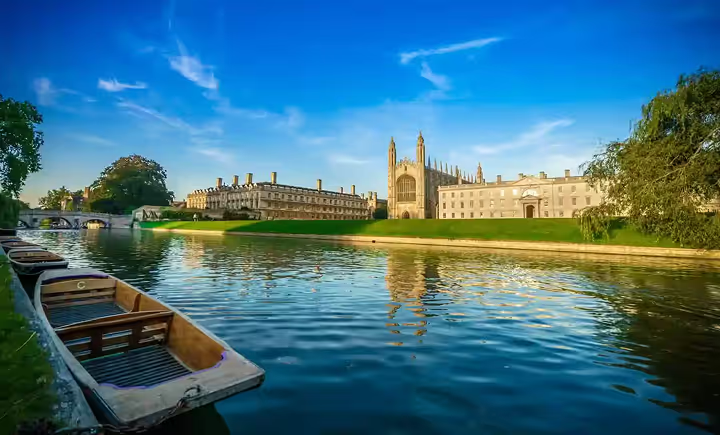
At the heart of Cambridge, woven into its colleges, courtyards, and riverside setting, stands one of the most influential academic institutions in the world: the University of Cambridge.
Unlike many universities with a clearly defined founding moment, Cambridge does not begin with a single date or event. Its origins are gradual, shaped by the movement of scholars, the development of teaching, and the formation of a new academic community that emerged from disruption and opportunity.
Today, Cambridge is recognised as one of the leading universities globally. However, its significance extends beyond reputation. What defines Cambridge is the continuity of its intellectual tradition — a system of learning that has evolved over centuries while remaining grounded in its earliest foundations.
For many, Cambridge represents more than an institution. It reflects a culture of inquiry, a commitment to discovery, and an environment where ideas are not only explored, but actively advanced.
What makes Cambridge particularly compelling is this balance. It is at once a historic institution shaped by centuries of tradition, and a modern university at the forefront of global research and innovation. This combination of heritage and progress is what distinguishes it from almost every other place of learning.
How did Cambridge University begin?
The origins of Cambridge University are closely linked to Oxford, but its creation was not simply an extension of another institution — it was the result of disruption, movement, and the re-establishment of academic life in a new setting.
In 1209, a group of scholars left Oxford following serious conflict with townspeople. Tensions between students and local residents were not uncommon in medieval university towns, where differences in status, law, and daily life often led to disputes. In this case, the situation escalated to the point where scholars chose to leave the city entirely.
Many of them travelled east to Cambridge.
At the time, Cambridge was a relatively small but established town, known for trade and its position along the River Cam. It did not yet have the academic identity of Oxford, but it offered something equally important — space, stability, and the opportunity to rebuild.
As these scholars settled, teaching began again. What started as a continuation of academic work quickly developed into something more distinct. A new community formed, shaped not only by what had been left behind, but by the conditions of this new environment.
Unlike institutions founded through royal charter or deliberate planning, Cambridge emerged organically. There was no single moment of creation, no defined structure at the outset. Instead, it grew through the presence of scholars, the demand for learning, and the gradual organisation of teaching.
Over time, this informal community developed into a recognised centre of education. Systems of governance were introduced, academic practices became more structured, and Cambridge began to establish its own identity — separate from Oxford, yet connected through its origins.
What began as a response to conflict became the foundation of one of the most influential universities in the world.
Why Cambridge became a centre of learning
Cambridge’s development as a centre of learning was shaped by a combination of geography, circumstance, and timing — but more importantly, by the conditions that allowed academic life to take root and expand.
When scholars arrived in the early 13th century, Cambridge was already an established town. It was not a major city, but it held strategic importance. Positioned along the River Cam and connected to regional trade routes, it functioned as a point of movement and exchange. This accessibility made it practical for scholars and students travelling from different parts of England.
However, what made Cambridge particularly suitable was not just its location, but its scale.
Compared to larger and more politically complex towns, Cambridge offered a more contained and manageable environment. For scholars who had left Oxford following conflict, this mattered. The town provided space to rebuild without the same level of tension or disruption. In this sense, Cambridge was not chosen solely for opportunity, but for stability.
Religious institutions also played an important role. Churches and ecclesiastical networks provided both physical spaces for teaching and a framework of authority that supported early academic life. In medieval Europe, education was closely tied to the Church, and Cambridge benefited from this connection as it developed.
As teaching activity increased, a pattern began to emerge. Scholars attracted students, students created demand, and demand required organisation. What had initially been an informal gathering of teachers and learners gradually became more structured.
This process was not immediate. It developed over decades, as systems of governance were introduced, teaching methods became more consistent, and the university gained recognition and legitimacy.
Over time, Cambridge transformed from a market town into a centre defined by intellectual activity.
What distinguished this transformation was not a single event, but a convergence of factors — location, circumstance, institutional support, and the presence of scholars — all contributing to the gradual formation of a university.
This combination allowed Cambridge not only to emerge, but to establish itself alongside Oxford as one of the defining centres of learning in England.
The early development of the university
By the early 13th century, Cambridge had begun to transition from an informal gathering of scholars into a more organised academic institution.
In its earliest form, teaching in Cambridge had been relatively unstructured. Scholars operated independently, attracting students through reputation rather than through any central system. There was little consistency in how teaching was delivered, and few mechanisms for regulating academic standards or behaviour.
As the number of students increased, this lack of structure became more difficult to sustain.
The growing academic community required clearer organisation — not only to support teaching, but to manage disputes, maintain order, and establish credibility. Without recognised authority, both scholars and students remained vulnerable to local tensions and legal uncertainty.
It was within this context that systems of governance began to emerge.
Gradually, the university developed a more defined internal structure. Roles were established to oversee academic activity, resolve conflicts, and represent the interests of scholars. Teaching became more consistent, and expectations around study and conduct were more clearly defined.
A key moment in this process came in 1231, when King Henry III granted the university royal recognition.
This recognition was significant for several reasons. It provided scholars with legal protections, reducing the risk of interference from local authorities, and it formally acknowledged the university as an institution with a defined role within English society.
Perhaps more importantly, it gave Cambridge legitimacy.
What had begun as a loosely connected group of individuals was now recognised as a structured and protected centre of learning. This allowed the university to grow with greater stability, attracting more scholars and students, and laying the foundations for further development.
From this point onwards, Cambridge was no longer simply forming — it had begun to establish itself.
The creation of colleges
As Cambridge continued to grow throughout the 13th century, the informal systems that had supported its early development began to come under pressure.
Increasing numbers of students created new challenges. Accommodation became difficult to manage, standards of behaviour varied widely, and there was little consistency in how teaching was delivered or supervised. Without clear structures in place, the university risked becoming unstable.
There was also a deeper issue. Students arriving in Cambridge were often young, financially vulnerable, and far from home. Without oversight, they were exposed not only to academic uncertainty, but to the practical difficulties of living in a busy town. Ensuring their welfare, as well as maintaining academic standards, became increasingly important.
In response to these challenges, a new model began to emerge — one that would fundamentally reshape the university.
This was the beginning of the collegiate system.
The first colleges
The first Cambridge college, Peterhouse, was founded in 1284 by Hugh de Balsham, the Bishop of Ely.
Its creation marked a significant shift. Rather than leaving students to organise their own accommodation and studies, Peterhouse provided a structured environment where both could be managed together. Students lived in a shared setting, followed defined rules, and received guidance as part of a formal academic community.
This model proved effective.
Over time, other colleges were established, including Clare College, Pembroke College, and Gonville and Caius College. Each followed a similar principle — creating self-contained communities that combined living, learning, and governance within a single institution.
These colleges introduced:
Organised teaching structures that supported more consistent learning
Academic supervision to guide and monitor student progress
Financial support through scholarships and endowments
A defined sense of identity, belonging, and intellectual community
This was not simply an administrative improvement. It represented a fundamental change in how education was experienced.
A defining model of learning
The collegiate system transformed Cambridge from a loose association of scholars into a structured and enduring institution.
Instead of operating as a single, centralised university, Cambridge became a network of colleges — each independent in its governance, yet connected through shared academic purpose.
This structure created a balance between individuality and unity. Colleges could develop their own traditions, cultures, and areas of focus, while still contributing to the wider intellectual life of the university.
It also strengthened the student experience.
By embedding teaching within smaller communities, the collegiate system allowed for closer academic relationships, greater support, and a more focused approach to learning. Students were no longer part of an undefined population, but members of a specific college with its own identity and expectations.
This model has endured for centuries.
Today, it remains one of the defining characteristics of Cambridge — shaping not only how the university operates, but how it is experienced.
A timeline of Cambridge University’s development
Understanding Cambridge requires looking at how it evolved over time. Its history is not defined by a single moment, but by a sequence of developments shaped by movement, reform, and intellectual change.
What follows is not simply a list of dates, but a progression of events that collectively transformed Cambridge from a small gathering of displaced scholars into one of the most influential academic institutions in the world.
1209 — The arrival of scholars
The origins of Cambridge University begin with disruption.
In 1209, scholars left Oxford following conflict with local townspeople and settled in Cambridge. What they brought with them was not an institution, but a way of learning — teaching practices, academic traditions, and the expectation of scholarly community.
At this stage, there was no formal university. Teaching was informal, governance was minimal, and the academic structure was still undefined. However, this moment established the foundation upon which everything else would be built.
1231 — Royal recognition
As the academic community grew, so did the need for legitimacy and protection.
In 1231, King Henry III granted Cambridge formal recognition. This was a defining moment in the university’s development. It provided scholars with legal status, protection from local authority interference, and recognition of their role within English society.
More importantly, it transformed Cambridge from a loosely organised group into an institution with authority. This recognition allowed the university to stabilise, attract more scholars, and begin developing systems of governance.
1284 — The founding of Peterhouse
The establishment of Peterhouse in 1284 marked the beginning of the collegiate system.
Until this point, students had largely been responsible for their own accommodation and organisation. The founding of a college introduced structure — bringing living, learning, and supervision into a single environment.
This was a turning point. It addressed many of the challenges facing the growing university, including discipline, welfare, and academic consistency.
Over time, additional colleges were founded, each reinforcing this new model and contributing to the university’s stability and identity.
14th–15th centuries — Expansion and consolidation
During the late medieval period, Cambridge expanded significantly.
New colleges were established, endowments increased, and the university became more embedded within the intellectual life of England. Teaching became more formalised, and academic disciplines began to take clearer shape.
This period was not simply one of growth, but of consolidation. The structures introduced in earlier centuries were strengthened, allowing Cambridge to operate as a more cohesive and stable institution.
16th century — Religious transformation
The Reformation brought profound change to Cambridge, as it did across England.
Religious institutions had been closely tied to education, and shifts in religious authority had direct consequences for the university. Colleges were affected by changing doctrines, leadership structures were altered, and the intellectual focus of the university began to shift.
At the same time, Cambridge became associated with significant religious thinkers and reformers, placing it at the centre of wider national debates.
This period demonstrated the university’s ability to adapt to external pressures while maintaining its academic function.
17th century — Scientific advancement
By the 17th century, Cambridge had become a centre of intellectual innovation, particularly in the fields of science and mathematics.
This period is often associated with major developments that would go on to influence global thought. The university became a place where new ideas were not only studied, but created — contributing to broader movements in science, philosophy, and understanding of the natural world.
This marked a shift in Cambridge’s identity. It was no longer defined solely by tradition, but increasingly by discovery.
19th century — Reform and modernisation
The 19th century brought significant reform to Cambridge.
Access to education began to expand, curricula were modernised, and new subjects were introduced. The university moved beyond its earlier focus on classical education, adapting to the needs of a changing society.
These reforms were not immediate, but they reshaped the university over time, making it more inclusive and academically diverse.
This period laid the foundations for Cambridge as a modern institution.
20th century — Global recognition
In the 20th century, Cambridge established itself as a global centre of learning.
It attracted students, academics, and researchers from around the world, contributing to international scholarship and innovation. Its influence extended beyond the UK, shaping academic thought on a global scale.
The university’s reputation during this period was built not only on its history, but on its continued contribution to new knowledge.
Today — A leading global university
Today, Cambridge continues to evolve.
It remains rooted in its collegiate structure and historical traditions, while operating as a modern institution at the forefront of research and education.
What defines Cambridge now is the balance it maintains — between continuity and change, tradition and innovation, history and progress.
It is this balance that has allowed it to endure, and to remain one of the most significant universities in the world.
The Cambridge teaching approach
One of the most distinctive aspects of Cambridge is not simply what is taught, but how learning takes place.
At its core is a system designed to move beyond passive understanding. Rather than focusing solely on lectures or content delivery, Cambridge places emphasis on small-group teaching, where ideas are explored in depth and students are expected to engage actively with their subject.
This approach reflects a broader philosophy — that education is not about absorbing information, but about developing the ability to think independently and critically.
Supervisions and discussion-based learning
Central to this model is the supervision system.
Supervisions are small-group teaching sessions, often involving just one or two students and a subject specialist. In these settings, learning becomes highly personalised. Students are typically required to prepare work in advance — essays, problem sets, or analyses — which then form the basis of detailed discussion.
This changes the nature of teaching.
Rather than listening to information, students are expected to explain their reasoning, defend their ideas, and respond to direct questioning. Tutors challenge assumptions, probe arguments, and guide discussion in a way that pushes students to refine their thinking.
The result is a more active and demanding form of learning.
It encourages:
Independent thinking, as students must develop their own ideas before discussion
Active participation, as engagement is expected rather than optional
Critical analysis, through direct questioning and feedback
Clarity of expression, as ideas must be articulated and defended
This environment creates a level of intellectual accountability that is difficult to achieve in larger teaching formats.
A focus on analytical thinking
The purpose of this approach is not simply to deepen subject knowledge, but to strengthen how students think.
At Cambridge, the emphasis is on analysis, reasoning, and intellectual independence. Students are encouraged to question assumptions, evaluate evidence, and construct well-supported arguments.
Learning becomes a process rather than an outcome.
Mistakes are not treated as failure, but as part of development. Through discussion and feedback, students refine their ideas, gaining a clearer understanding not only of the subject itself, but of how to approach complex problems.
This focus extends beyond academic study.
The ability to think critically, communicate clearly, and engage with challenging ideas is central to the Cambridge experience, shaping how students approach learning both during and after their time at the university.
The experience of studying in Cambridge
What distinguishes Cambridge is not only its teaching method, but the environment in which that learning takes place.
The structure of the university is closely tied to the city itself, creating an experience where academic life is not separate from daily life, but fully integrated within it.
A city built around learning
Cambridge does not operate as a single, defined campus.
Instead, the university is embedded throughout the city. Colleges, libraries, lecture halls, and study spaces are woven into its streets, courtyards, and riverside setting.
This creates a different kind of academic environment.
Moving between teaching spaces involves walking through the city itself — past historic buildings, across college grounds, and along the River Cam. The physical setting reinforces the sense that learning is not confined to a single place, but part of a wider intellectual landscape.
The city becomes part of the experience of studying.
A global academic community
Cambridge also brings together students from a wide range of backgrounds and countries.
This diversity plays a significant role in shaping the academic environment. Different perspectives influence discussion, challenge assumptions, and broaden understanding.
Conversations extend beyond formal teaching.
They continue in college spaces, during meals, and in informal settings, creating a continuous exchange of ideas. This dynamic contributes to a culture where learning is collaborative as well as individual.
The result is an environment where academic development is shaped not only by teaching, but by interaction — with tutors, peers, and the wider community.
Why Cambridge continues to matter
Cambridge’s significance lies not only in its history, but in its continued ability to shape how knowledge is developed, understood, and applied.
Over the centuries, it has evolved from a small community of scholars into a global centre of intellectual influence. What distinguishes Cambridge is not simply the longevity of the institution, but the consistency of its contribution. It has remained relevant not by preserving tradition alone, but by continually engaging with new ideas and advancing understanding across disciplines.
Its impact can be seen in multiple dimensions.
Academically, Cambridge has played a central role in the development of modern education. The structures it helped establish — from collegiate systems to small-group teaching — continue to influence how learning is organised and delivered around the world.
Intellectually, it has been associated with significant advances in science, mathematics, philosophy, and the humanities. It is a place where ideas are not only studied, but created — where theoretical thinking has led to practical and often transformative outcomes.
Culturally, Cambridge represents a model of inquiry. The emphasis on questioning, discussion, and analytical thinking reflects a broader approach to knowledge — one that prioritises understanding over memorisation, and depth over simplicity.
Its influence also extends globally.
Through its research, teaching, and alumni, Cambridge has contributed to developments across industries, governments, and academic fields. Its reach is not limited to the city itself, but extends into wider intellectual and professional landscapes.
What allows Cambridge to maintain this level of influence is its ability to balance continuity with change.
It remains rooted in its collegiate structure and long-established traditions, while continuing to adapt to new challenges, new disciplines, and new ways of thinking.
Few institutions have sustained this balance over such a long period of time.
Cambridge matters not simply because of what it has been, but because of what it continues to be — a place where ideas are developed, challenged, and carried forward into the future.
Experience Cambridge for yourself
Cambridge is not simply a city shaped by academic history — it is a place where that history continues to influence everyday life.
Across its colleges, green spaces, and riverside setting, centuries of tradition exist alongside modern research and innovation, creating an environment that feels both historic and forward-looking.
Walking through Cambridge offers more than a visual experience. It provides insight into how ideas have developed over time, and how they continue to shape the present.
If you would like to experience this environment more closely, you can explore what it’s like to live and learn in Cambridge through Oxford Summer Courses.
To find out more about course availability, dates, and programme options, visit Oxford Summer Courses prices and dates.
Frequently Asked Questions
The University of Cambridge does not have a single formal founding date, but its origins are generally traced to 1209, when scholars left Oxford and began teaching in Cambridge. Over time, this informal academic community developed into a structured institution, particularly after receiving royal recognition in 1231. Like Oxford, Cambridge emerged gradually rather than being established at a specific moment.
Cambridge was not deliberately created as a rival to Oxford. Instead, it developed as a result of conflict. In 1209, disputes between scholars and townspeople in Oxford led to a group of academics leaving the city. They settled in Cambridge, where they continued their teaching. This relocation led to the formation of a new academic community, which eventually became the University of Cambridge.
Cambridge University is made up of individual colleges, each functioning as a self-contained academic community. This system began in the 13th century with the founding of Peterhouse in 1284. Colleges provide accommodation, academic support, and a sense of identity for students. While the university oversees teaching and degrees, much of student life and learning is shaped by the college system, which remains central to Cambridge today.
Teaching at Cambridge is characterised by its supervision system, which focuses on small-group learning. Students typically meet with a tutor in groups of one or two to discuss their work in depth. This allows for highly personalised teaching, where ideas are explored through discussion rather than delivered through lectures alone. The emphasis is on critical thinking, analysis, and the ability to articulate and defend ideas.
Cambridge is widely regarded as one of the leading universities globally due to its long history of academic excellence, its contribution to research and innovation, and its distinctive teaching approach. It has been associated with major developments in science, mathematics, and the humanities, and continues to attract students and academics from around the world. Its ability to combine tradition with ongoing intellectual advancement is a key part of its global reputation.
Summary
The University of Cambridge is one of the world’s leading centres of learning, with origins dating back to 1209. Emerging from a community of scholars, it developed into a structured collegiate university known for its academic excellence and global influence. Today, Cambridge continues to shape education and research while remaining deeply rooted in its history and traditions.