
What Are the Hardest University Degrees and Majors?

Key takeaways:
Choosing a university degree is one of the most important academic decisions you’ll make—and not all degrees are equally demanding. Some courses are known for their intense workload, complex concepts, and high expectations, making them significantly more challenging than others.
If you're wondering **what the hardest university degrees or majors are—and which is the hardest degree to get into—**you're not alone. Many students want to understand which subjects are the most difficult before committing to years of study. However, “hard” can mean different things depending on the course, your strengths, and how the degree is assessed.
In this guide, we break down the hardest degrees and majors, explain what makes them so challenging, and explore how difficulty varies across subjects. Whether you’re aiming for Medicine, Engineering, Law, or another competitive field, this article will help you make a more informed and confident decision.
What Makes a Degree One of the Hardest?
Before comparing specific subjects, it’s important to understand what actually makes a degree difficult. The hardest degrees are rarely challenging for just one reason—they typically combine multiple types of difficulty, from complex academic content to intense workloads and high-pressure assessments.
Understanding these factors can help you identify not just which degrees are hardest—but why they are challenging, and whether they’re the right fit for you.
Academic Complexity
Some degrees are difficult because of the way you have to think. Subjects like Mathematics, Physics, and Engineering move far beyond memorisation and require deep conceptual understanding, abstract reasoning, and the ability to apply ideas to unfamiliar problems.
At university level, this often means:
- Working with theories that have no obvious real-world examples
- Solving problems that don’t follow a fixed method
- Understanding concepts rather than memorising answers
This shift in thinking is one of the biggest challenges students face when transitioning from school to university.
Workload and Time Commitment
Other degrees are demanding because of the sheer volume of work. Courses such as Medicine and Architecture require long hours, continuous assessment, and significant independent study.
Students are often expected to balance:
- Lectures and seminars
- Coursework and projects
- Practical or clinical work
- Ongoing revision
In many cases, the challenge is not just understanding the material—but managing your time effectively across multiple commitments.
Assessment Style
Different degrees are challenging in different ways depending on how you’re assessed.
- STEM subjects focus on problem-solving, calculations, and accuracy under time pressure
- Humanities subjects require essay writing, critical analysis, and the ability to construct well-supported arguments
While STEM degrees are often seen as more technical, essay-based subjects can be equally demanding due to the level of independent thinking and interpretation required.
Pressure and Competition
Some of the hardest degrees are also the most competitive, which adds an additional layer of difficulty. Courses like Medicine, Law, and Engineering often have high expectations, strict grading, and competitive environments.
This can involve:
- High-stakes exams
- Competitive grading curves
- Pressure to maintain consistently strong performance
Over time, this sustained pressure can make even manageable content feel significantly more challenging.
Key Insight
The hardest degrees combine several of these factors at once—for example, Medicine involves both high workload and high pressure, while Mathematics combines abstract thinking with conceptual difficulty.
Hardest Degrees at a Glance
If you’re comparing the hardest university degrees and majors, the table below provides a quick overview of the most challenging subjects, what makes them difficult, and the type of skills they require. While every degree has its own demands, the courses listed here are consistently ranked among the hardest due to their combination of academic complexity, workload, and pressure.

This overview highlights general patterns, but the difficulty of a degree will ultimately depend on your individual strengths, interests, and learning style.
Top 10 Hardest University Degrees and Majors
Medicine
Medicine is widely considered one of the hardest university degrees—and one of the hardest degrees to get into.
Why it’s hard:
- Extremely high workload across multiple years
- Long course duration (typically 5–6 years)
- Clinical placements involving real patient care
- Continuous assessment rather than one final exam
What you’ll study:
Human anatomy, physiology, pharmacology, pathology, and clinical practice.
What universities expect:
Most medical schools require Chemistry and Biology at A-Level, along with top grades and strong performance in admissions tests.
Key insight:
Medicine is not just academically demanding—it also requires emotional resilience, communication skills, and the ability to perform under pressure.
You can explore this subject early through Medicine summer courses.
Engineering
Engineering is one of the hardest majors due to its combination of theoretical knowledge and practical application.
Why it’s hard:
- Advanced mathematics and physics
- Complex real-world problem-solving
- Group projects and technical coursework
- Multiple disciplines within one degree
What you’ll study:
Mechanics, thermodynamics, electronics, materials science, and systems design.
What universities expect:
Maths and Physics are essential, with Further Maths often preferred at top universities.
Key insight:
Engineering is challenging because you must apply theory to solve real-world problems—there is rarely a single “correct” answer.
Explore this pathway through Engineering summer courses.
Mathematics
Mathematics is one of the most intellectually demanding degrees due to its abstract nature.
Why it’s hard:
- Proof-based learning replaces calculation
- Abstract concepts with no real-world context
- Requires sustained logical reasoning
What you’ll study:
Pure mathematics, algebra, number theory, calculus, and mathematical proofs.
What universities expect:
A-Level Maths is essential, with Further Maths strongly recommended.
Key insight:
Many students struggle with the transition from procedural maths to theoretical maths—it’s a completely different way of thinking.
Explore further through Mathematics summer courses.
Physics
Physics is one of the hardest degrees due to its blend of abstract theory and mathematical application.
Why it’s hard:
- Complex theories such as quantum mechanics
- Mathematical modelling and equations
- Requires both intuition and precision
What you’ll study:
Mechanics, electromagnetism, relativity, and quantum physics.
What universities expect:
Maths and Physics, often alongside Further Maths.
Key insight:
Physics requires deep conceptual understanding—memorising formulas is not enough.
Explore through Physics summer courses.
Law
Law is one of the most demanding humanities degrees.
Why it’s hard:
- Large volume of reading
- Complex legal reasoning
- Essay-based assessments under time pressure
What you’ll study:
Criminal law, contract law, constitutional law, and legal theory.
What universities expect:
Strong essay-based subjects and analytical ability.
Key insight:
Law is difficult because of how much you need to interpret, evaluate, and argue—not just understand.
Explore legal study via Law summer courses.
Architecture
Architecture combines creativity with technical expertise.
Why it’s hard:
- Long studio hours
- Intensive design projects
- Continuous deadlines
What you’ll study:
Design, structural principles, materials, and architectural history.
What universities expect:
A strong portfolio and a balance of creative and technical skills.
Key insight:
Architecture is one of the most time-intensive degrees—students often work beyond standard academic hours.
Explore via Architecture summer courses.
Chemistry
Chemistry is a demanding science due to its conceptual and practical components.
Why it’s hard:
- Abstract concepts (especially organic chemistry)
- Laboratory work and detailed reports
- Requires precision and accuracy
What you’ll study:
Organic, inorganic, and physical chemistry.
What universities expect:
Chemistry plus another science or Maths.
Key insight:
Success in Chemistry requires both understanding and application—memorisation alone is not enough.
Explore via Chemistry summer courses.
Computer Science
Computer Science is one of the most technical and fast-evolving degrees.
Why it’s hard:
- Programming challenges
- Algorithmic thinking
- Mathematical foundations
What you’ll study:
Algorithms, data structures, machine learning, and software engineering.
What universities expect:
Maths is essential, with Further Maths often preferred.
Key insight:
The hardest part is not coding—it’s learning how to think logically and solve problems efficiently.
Explore via Computer Science summer courses.
Psychology
Psychology is often underestimated but highly analytical.
Why it’s hard:
- Statistical analysis
- Research methods
- Scientific writing
What you’ll study:
Cognitive psychology, neuroscience, behavioural science.
What universities expect:
Science or analytical subjects such as Biology or Maths.
Key insight:
Many students find the research and statistics components more challenging than expected.
Explore via Psychology summer courses.
Economics
Economics is one of the hardest degrees at top universities due to its quantitative nature.
Why it’s hard:
- Mathematical models
- Data interpretation
- Abstract theory
What you’ll study:
Microeconomics, macroeconomics, econometrics.
What universities expect:
Maths is essential, with Further Maths preferred.
Key insight:
Economics is far more mathematical than many students expect.
Explore via Economics summer courses.
Which Is the Hardest Degree to Get Into?
Some degrees are difficult not because of the content—but because of how competitive they are to enter. In fact, the hardest degree to get into is often defined by limited places, high applicant numbers, and demanding selection processes rather than academic difficulty alone.
Courses such as Medicine, Dentistry, and Veterinary Medicine consistently rank among the most competitive university degrees in the UK. This is because they combine strict academic requirements with additional stages of assessment beyond standard applications.
The hardest degrees to get into typically include:
- Medicine
- Dentistry
- Veterinary Medicine
- Law (at top universities)
- Engineering (at highly selective institutions)
Why these degrees are so competitive
These courses often require far more than just strong A-Level results. Applicants are usually expected to demonstrate a combination of academic excellence, aptitude, and commitment to the subject.
This can include:
- Exceptional grades (often A*AA or higher)
- Admissions tests (such as UCAT, LNAT, or subject-specific exams)
- Interviews that assess critical thinking, communication, and subject understanding
- Work experience or subject engagement, particularly for Medicine and related fields
In many cases, thousands of applicants compete for a relatively small number of places, making the process highly selective.
Key insight
The hardest degree to get into is not always the hardest to study. For example, Mathematics and Physics are often considered among the most academically challenging degrees, but Medicine is typically harder to access due to the competitive admissions process.
Understanding this distinction is important when deciding which path to pursue—especially if you are aiming for a top university.
Hardest Degrees vs Hardest Majors: Key Differences
The terms “degree” and “major” are often used interchangeably, but they can have slightly different meanings depending on the education system. Understanding this distinction is important when comparing advice, rankings, and course difficulty globally.
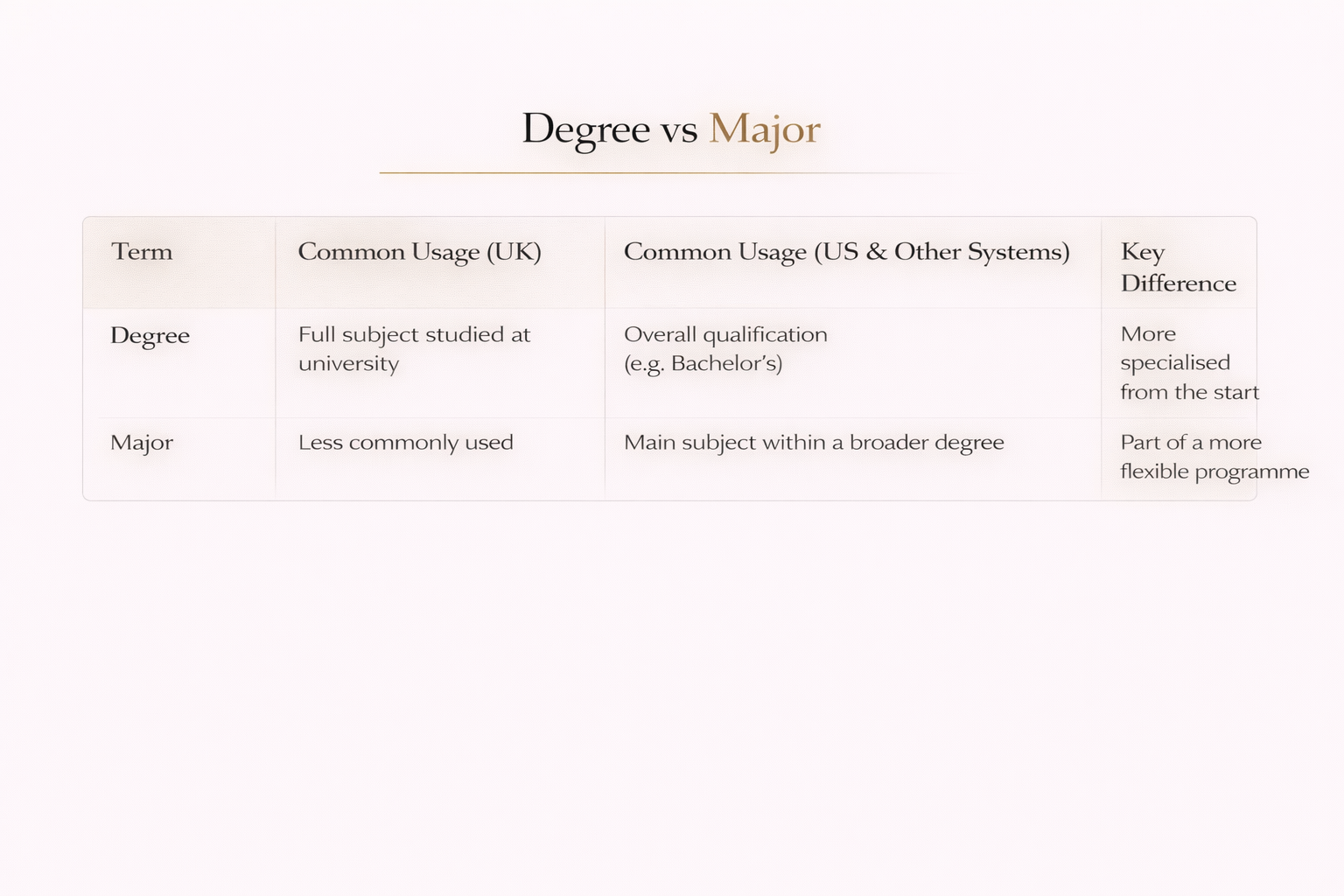
While the terminology differs, the hardest degrees and hardest majors are largely the same subjects worldwide. Fields such as Medicine, Engineering, Mathematics, and Physics are consistently ranked among the most challenging due to their combination of complexity, workload, and academic demands.
Understanding this distinction helps you interpret advice more accurately and ensures you’re comparing like-for-like when researching your options—especially when looking at global rankings or university requirements.
How to Choose the Right Degree for You
Choosing a degree based purely on difficulty is rarely the best strategy. While it’s useful to understand which subjects are considered the hardest, the right choice ultimately depends on how well a course aligns with your strengths, interests, and long-term goals.
A degree that is challenging but engaging will feel far more manageable than one that you struggle to stay motivated in.
Consider your strengths
Start by thinking about the subjects you perform best in and feel most confident with. For example:
- If you enjoy problem-solving and logical thinking, degrees like Mathematics, Engineering, or Computer Science may suit you
- If you prefer writing, analysis, and discussion, subjects like Law or humanities-based degrees may be a better fit
Choosing a subject that plays to your strengths can make even a difficult degree more manageable.
Think about your interests
Interest is one of the biggest factors in long-term success. University degrees require sustained focus over several years, so choosing a subject you genuinely enjoy is essential.
Ask yourself:
- Do I find this subject interesting beyond school?
- Would I be motivated to study this independently?
- Can I see myself engaging with this subject long-term?
A strong interest can make a challenging course feel far more rewarding.
Understand the reality of the course
Many students choose degrees based on assumptions rather than a clear understanding of what the subject involves.
For example:
- Economics is far more mathematical than many expect
- Law involves extensive reading and essay writing
- Medicine requires long hours and emotional resilience
Researching course content, teaching style, and assessment methods can help you avoid unexpected challenges later.
Consider your long-term goals
Your degree should also align with your future plans. Some careers require specific degrees (e.g. Medicine, Architecture), while others are more flexible.
Think about:
- What career paths interest you
- Whether the degree is required or preferred
- What skills you want to develop
This helps ensure your choice supports your long-term direction.
Gain experience before deciding
One of the most effective ways to choose the right degree is to experience subjects beyond the school curriculum.
Programmes like Oxford Summer Courses allow students to explore subjects in a more advanced, discussion-led environment. This can help you understand not only the difficulty of a subject, but whether it’s the right fit for you.
Key insight
The best degree is not the easiest—or the hardest—it’s the one that challenges you while keeping you engaged, motivated, and confident in your ability to succeed.
How Oxford Summer Courses Can Help You Explore Challenging Degrees
If you’re considering one of the hardest university degrees, gaining early exposure to the subject can make a significant difference. Many students choose courses based on assumptions—only to realise later that the content, workload, or teaching style is very different from what they expected.
Programmes like Oxford Summer Courses give students the opportunity to explore challenging subjects in a more advanced, discussion-led environment. With over 40 subjects available, including Medicine, Engineering, Law, and Economics, you can experience what studying these degrees is really like before making a long-term commitment.
Unlike traditional classroom learning, there is no fixed syllabus. This means teaching is tailored to your interests, questions, and academic level—allowing you to engage more deeply with topics and develop your own ideas.
Through this kind of experience, you can:
- Understand the real difficulty of a subject beyond school-level expectations
- Experience university-style learning, including discussion and independent thinking
- Build confidence in your academic abilities
- Compare multiple subjects over time before choosing a degree
This makes it much easier to decide not only which degrees are the hardest—but which ones are the right fit for you.
Final Thoughts: Are the Hardest Degrees Worth It?
The hardest university degrees and majors are often the most intellectually demanding—but they can also be the most rewarding. Subjects like Medicine, Engineering, and Mathematics push you to develop advanced skills, resilience, and a deeper understanding of your field.
However, difficulty alone should never be the deciding factor.
The key is not choosing the hardest degree—but choosing the one that best aligns with your strengths, interests, and long-term goals. A subject that challenges you while keeping you engaged will always lead to better outcomes than one chosen purely for its reputation.
It’s also important to remember that “hard” is subjective. What feels difficult for one student may come naturally to another, depending on their abilities and learning style.
By understanding what makes a degree challenging—and gaining early exposure where possible—you can make a more confident, informed decision about your future.
Ultimately, the right degree is one that motivates you to grow, supports your ambitions, and prepares you for long-term success.
Frequently Asked Questions
Medicine is often considered the hardest university degree due to its intense workload, long duration, and high-pressure clinical training. However, subjects like Mathematics and Physics are also extremely challenging because of their abstract and technical nature.
Some of the hardest majors globally include Medicine, Engineering, Mathematics, Physics, and Chemistry. These subjects are consistently ranked among the most difficult due to their complexity, workload, and level of problem-solving required.
Medicine is widely considered the hardest degree to get into, as it requires top grades, admissions tests, interviews, and often relevant work experience. Other highly competitive degrees include Dentistry, Veterinary Medicine, and Law at top universities.
STEM degrees are often seen as more technically demanding, while humanities degrees require strong analytical thinking and extensive writing. Both can be equally challenging depending on your strengths and learning style.
Choosing the hardest degree is not always the best decision. It’s more important to select a subject that matches your interests, strengths, and long-term goals, as this will make the degree more manageable and rewarding.
Summary
This guide explores the hardest university degrees and majors, explaining what makes them challenging—from academic complexity to workload and competition—and which are hardest to get into. It highlights subjects like Medicine, Engineering, and Mathematics, while helping you understand how to choose a degree that fits your strengths, interests, and long-term goals.