
What Are the Best A-Level Combinations by Subject?


Key takeaways:
Choosing your A-Level subjects is one of the most important academic decisions you’ll make. The combination you choose can directly impact which university courses you can apply for—and how competitive your application will be.
If you're aiming for top universities or competitive degrees like Medicine, Engineering, Law, or Economics, your subject choices matter just as much as your final grades.
In this guide, we’ll explain what the best A-Level combinations are by subject, why they matter, and how to choose the right combination based on your goals.
Why Are A-Level Subject Combinations So Important?
A-Level choices are not just about what you enjoy—they are a strategic decision that can shape your academic future.
Universities assess three key things when reviewing your application:
1. Subject Requirements
Some degrees have strict entry requirements. For example:
- Medicine almost always requires Chemistry + Biology
- Engineering requires Maths + Physics
- Economics typically requires Maths
If you don’t meet these requirements, you may not be eligible to apply.
2. Academic Rigour
Top universities prefer subjects that demonstrate strong academic ability. Traditional, analytical subjects signal that you can handle challenging content and succeed in a demanding academic environment.
3. Evidence of Potential
Your A-Level combination shows how prepared you are for your chosen course:
- Further Maths → readiness for quantitative degrees
- Essay subjects → critical thinking and argumentation
- Sciences → logical reasoning and analytical skills
What Are the Most Respected A-Level Subjects?
Some A-Level subjects are more widely accepted by universities, especially for competitive courses.
These include:
- Maths
- Further Maths
- English Literature
- Physics
- Chemistry
- Biology
- History
- Geography
These subjects are valued because they:
- Keep the most degree options open
- Demonstrate academic strength
- Develop transferable skills like analysis and communication
Key insight:
If you’re unsure about your future degree, choosing at least one or two of these subjects is the safest way to keep your options open.
Best A-Level Combinations for Medicine
Recommended combination:
- Biology
- Chemistry
- Maths
Medicine is one of the most competitive degree programmes in the UK, and most universities require Chemistry alongside another science.
Why this combination works:
- Chemistry is essential for nearly all medical schools
- Biology supports understanding of human systems and physiology
- Maths strengthens analytical thinking and data interpretation
What universities expect:
Most UK medical schools require Chemistry and at least one other science (usually Biology). Applicants are also expected to achieve high grades and perform well in admissions tests such as the UCAT or BMAT.
Key insight:
While Maths is not always required, it often gives applicants a competitive edge—particularly at top universities where analytical ability is highly valued.
If you're considering Medicine, it’s worth exploring the subject early through programmes like Medicine summer courses to gain a clearer understanding of what studying medicine actually involves.
Best A-Level Combinations for Engineering
Recommended combination:
- Maths
- Physics
- Further Maths
Engineering degrees are highly mathematical, particularly at top universities.
Why this combination works:
- Maths is essential for all engineering disciplines
- Physics develops problem-solving and real-world application
- Further Maths demonstrates strong quantitative ability
What universities expect:
Most engineering courses require Maths and Physics. Highly competitive universities often expect Further Maths if it is available at your school.
Key insight:
If your school offers Further Maths, not taking it can weaken your application for competitive engineering courses—even if it is not formally required.
Best A-Level Combinations for Law
Recommended combination:
- English Literature
- History
- Politics
Law degrees do not require specific A-Levels, but subject choice still matters.
Why this combination works:
- English develops critical reading and argumentation
- History builds structured essay-writing and evaluation skills
- Politics introduces debate and real-world context
What universities expect:
There are no required A-Level subjects for Law, but universities look for strong essay-based subjects that demonstrate critical thinking, argumentation, and clarity of expression.
Key insight:
A-Level Law is not required—and is often less valuable than traditional essay-based subjects.
You can explore legal thinking further through Law summer courses.
Best A-Level Combinations for Economics
Recommended combination:
- Maths
- Economics
- Further Maths
Economics at university is far more mathematical than many students expect.
Why this combination works:
- Maths is essential and often required
- Further Maths significantly strengthens your application
- Economics provides useful context, though not always necessary
What universities expect:
Most top universities require A-Level Maths for Economics, and many strongly prefer applicants who have also taken Further Maths.
Key insight:
At top universities, Maths is far more important than Economics. Many successful applicants have not studied Economics at A-Level but have strong mathematical backgrounds.
Best A-Level Combinations for Computer Science
Recommended combination:
- Maths
- Computer Science
- Physics
Computer Science is a highly analytical subject with a strong mathematical foundation.
Why this combination works:
- Maths underpins algorithms and computational thinking
- Physics strengthens logic and structured problem-solving
- Computer Science builds programming knowledge
What universities expect:
Maths is typically required for Computer Science degrees, and Further Maths is highly recommended at competitive universities.
Key insight:
Many top universities do not require A-Level Computer Science—but they do prioritise Maths and Further Maths.
Best A-Level Combinations for Psychology
Recommended combination:
- Psychology
- Biology
- Maths
Psychology combines elements of science and social science.
Why this combination works:
- Biology supports understanding of the brain and behaviour
- Maths is essential for statistics and research methods
- Psychology introduces key theories and concepts
What universities expect:
Psychology degrees do not usually require specific A-Levels, but universities often prefer a mix of science and analytical subjects, particularly Biology and Maths.
Key insight:
Maths is often underestimated—but it is one of the most valuable subjects for psychology at university level.
Best A-Level Combinations for Architecture
Recommended combination:
- Maths
- Art
- Physics
Architecture requires both creativity and technical understanding.
Why this combination works:
- Art supports portfolio development and creativity
- Maths aids structural understanding
- Physics supports design and materials knowledge
What universities expect:
Most architecture courses require a strong portfolio, alongside subjects that demonstrate both creativity and technical ability.
Key insight:
Your portfolio is often just as important as your A-Level subjects when applying for architecture.
Best A-Level Combinations for English Literature
Recommended combination:
- English Literature
- History
- Classics
This pathway focuses on reading, writing, and analysis.
Why this combination works:
- English is essential
- History strengthens essay-writing and argumentation
- Classics deepens cultural and literary understanding
What universities expect:
English Literature is typically required, and universities look for strong essay-based subjects that demonstrate analytical thinking and depth of reading.
Key insight:
Universities value depth of analysis more than subject variety in this field.
Best A-Level Combinations for Natural Sciences
Recommended combination:
- Maths
- Chemistry
- Physics or Biology
Natural Sciences is flexible but academically demanding.
Why this combination works:
- Maths underpins all scientific study
- Chemistry is central to many pathways
- Physics or Biology allows for specialisation
What universities expect:
Most Natural Sciences courses require at least two science subjects, often including Maths and Chemistry.
Key insight:
A broad science combination keeps multiple pathways open and allows for flexibility at university level.
Best A-Level Combinations for Business and Management
Recommended combination:
- Maths
- Economics
- Business Studies
Business degrees benefit from both analytical and applied knowledge.
Why this combination works:
- Maths develops analytical and quantitative skills
- Economics provides theoretical understanding
- Business offers practical insight
What universities expect:
Business and Management degrees typically have flexible entry requirements, but top universities often prefer applicants with strong analytical subjects such as Maths and Economics.
Key insight:
Traditional academic subjects are often valued more highly than purely vocational ones at competitive universities.
Best A-Level Combinations at a Glance
If you’re comparing different degree options, this table summarises the most effective A-Level combinations and key requirements:
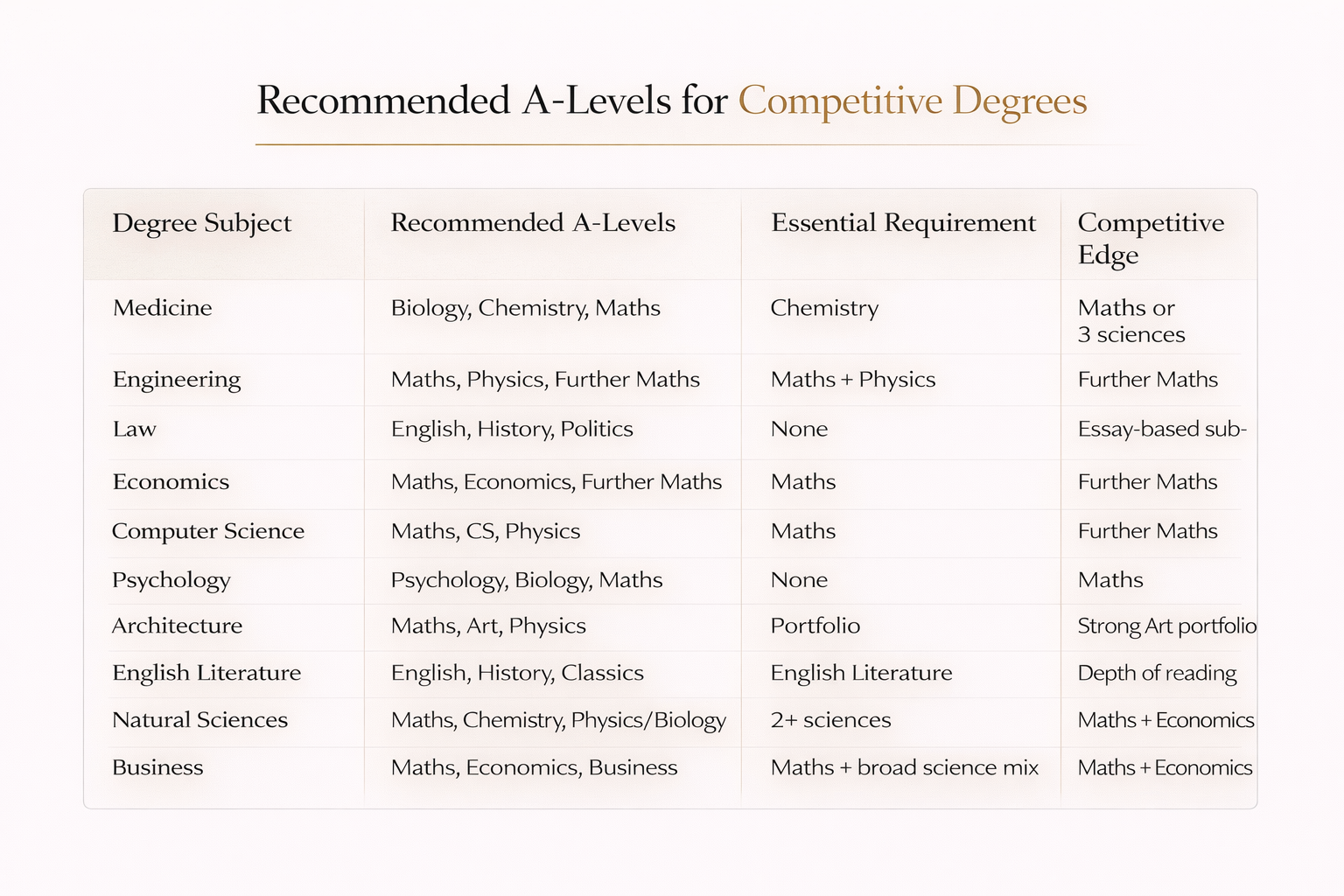
This overview provides a quick starting point, but your final A-Level choices should always reflect both university requirements and your individual strengths.
What Is the Best A-Level Combination Overall?
There is no single “best” combination—but the strongest choices usually include:
- Maths (the most versatile subject)
- At least one facilitating subject
- Subjects aligned with your degree goals
If you’re unsure, a flexible combination like Maths + a science + an essay subject keeps the most options open.
Common Mistakes to Avoid When Choosing A-Levels
- Choosing subjects based only on perceived difficulty
- Ignoring university requirements
- Taking too many A-Levels
- Closing off options too early
Key insight:
Strategic subject choice matters just as much as achieving high grades.
How Oxford Summer Courses Can Help You Choose the Right A-Levels
Choosing the right A-Level combination can be challenging if you’re unsure what you want to study at university. Many students make decisions based on limited exposure to subjects—only to realise later that studying them in depth is very different.
Programmes like Oxford Summer Courses help students explore over 40 subjects in a more academic, discussion-led environment—giving you a clearer understanding of both the content and the experience of studying a subject at a higher level.
Key benefits include:
- Explore 40+ subjects before committing
- No fixed syllabus, with learning tailored to your interests
- Opportunity to study multiple courses over time
- Small-group teaching with expert tutors (meet our tutors)
You can also learn more about the experience on why choose Oxford Summer Courses.
Ultimately, the best A-Level choices come from experience, not guesswork.
Final Thoughts: Choosing the Best A-Level Combination
Choosing the best A-Level combination isn’t about picking the “hardest” subjects—it’s about making informed, strategic decisions that align with your future goals.
The strongest combinations are those that:
- Meet university entry requirements
- Demonstrate academic rigour and subject strength
- Develop the skills needed for your chosen degree
- Keep your options open if you’re still undecided
What sets successful students apart is not just what they choose, but how they choose. Those who take the time to explore subjects, understand university expectations, and reflect on their interests are far more likely to make confident, effective decisions.
If you’re still unsure, gaining real academic exposure can make all the difference. Exploring subjects in a more advanced, discussion-led environment—such as through Oxford Summer Courses—can help you move from uncertainty to clarity.
When you understand what you enjoy and what you’re capable of, choosing your A-Levels becomes much simpler—and much more strategic.
If you’re ready to take the next step, you can apply now or explore subjects that match your interests.
Frequently Asked Questions
The best A-Level combinations depend on your chosen degree, but strong options usually include subjects like Maths, Sciences, and essay-based disciplines. These are widely accepted by universities and demonstrate academic rigour.
Top universities often require specific subjects depending on the course. For example, Medicine typically requires Chemistry and Biology, while Economics usually requires Maths. Always check individual university requirements before choosing.
Most universities prefer three strong A-Levels rather than four average ones. Taking four can be beneficial in some cases, but only if you can maintain high grades across all subjects.
Yes, universities tend to prefer traditional academic subjects such as Maths, Sciences, English Literature, and History. These subjects are seen as more rigorous and better preparation for degree-level study.
If you’re unsure, choose a balanced combination that keeps your options open—such as Maths, a science, and an essay-based subject. Exploring subjects outside the classroom, for example through Oxford Summer Courses, can also help you make a more informed decision.
About the author
Rhys Mackenzie is responsible for creating and maintaining educational content at Oxford Summer Courses, helping students and families access clear, accurate information about studying in Oxford. With several years of experience in digital content and student-focused resources, Rhys specialises in presenting academic programmes in a way that reflects the quality and integrity of the Oxford learning experience. Learn more about Rhys here.
Summary
This guide outlines the best A-Level combinations by subject, helping you choose based on university requirements, strengths, and career goals. It highlights key subjects for competitive degrees and shows how making informed choices can strengthen your application and keep your options open.